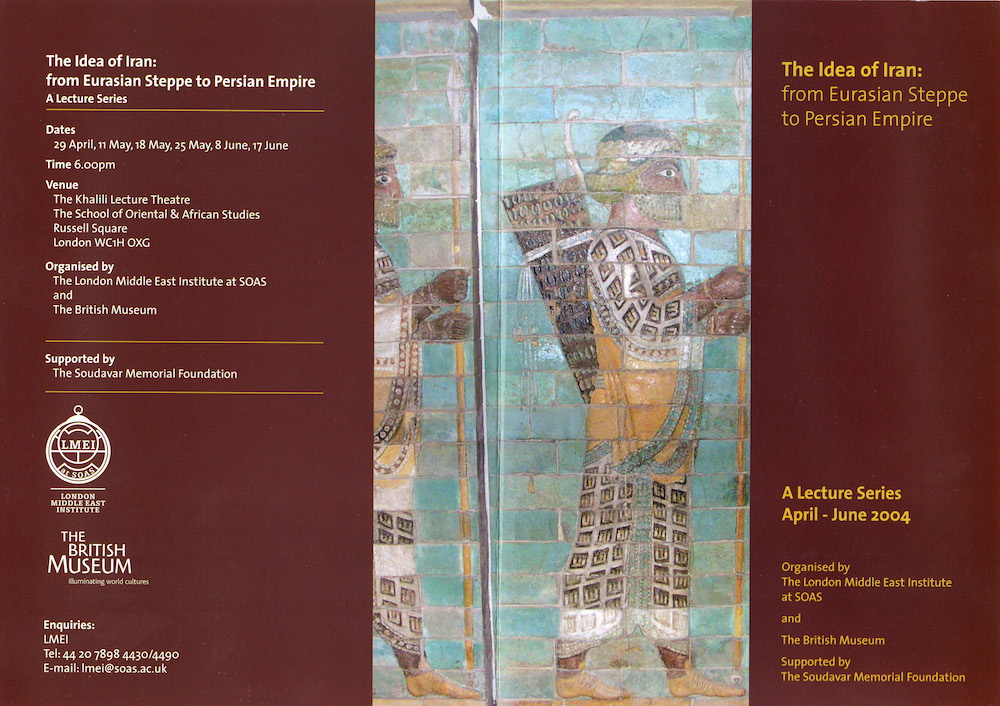
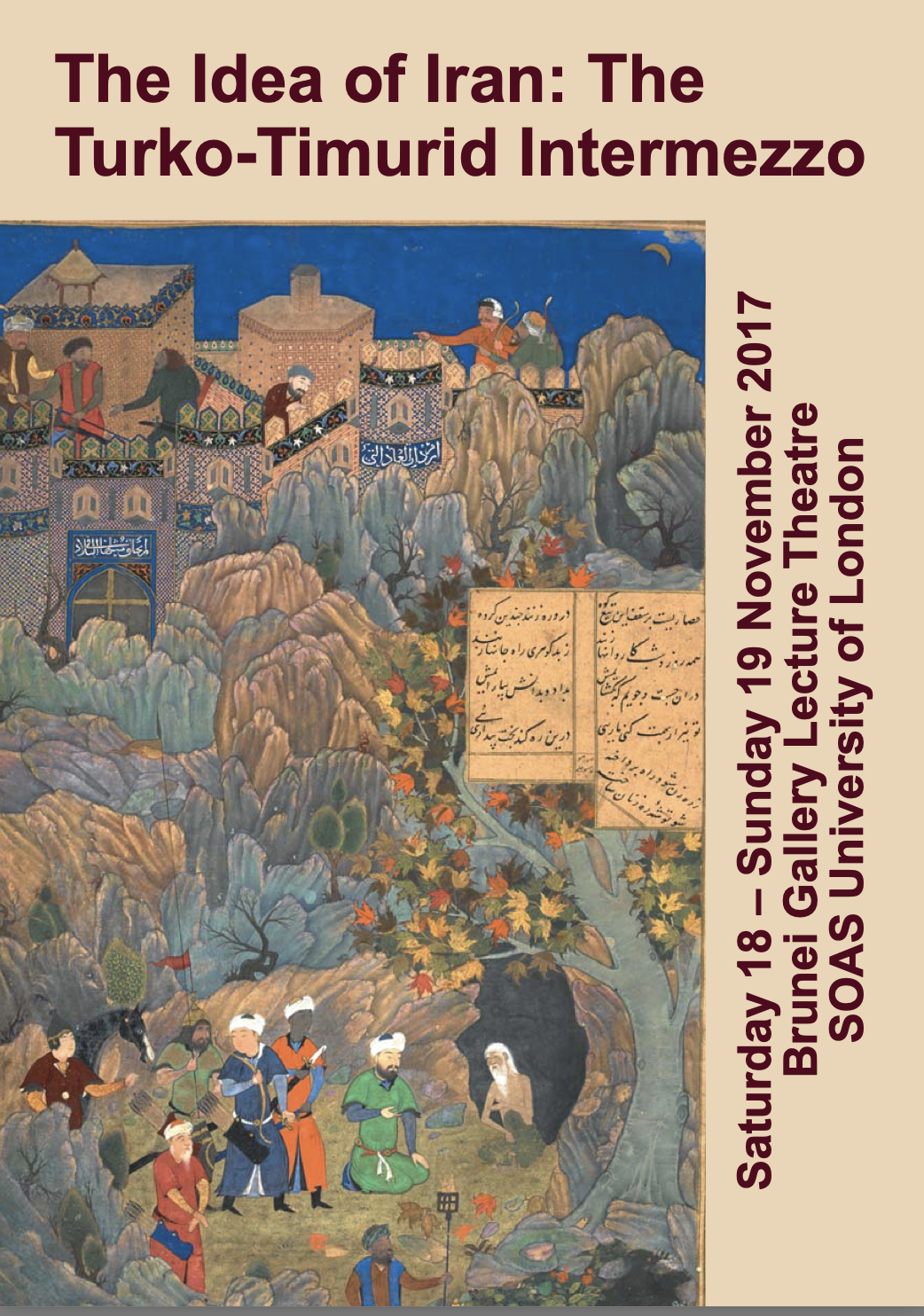
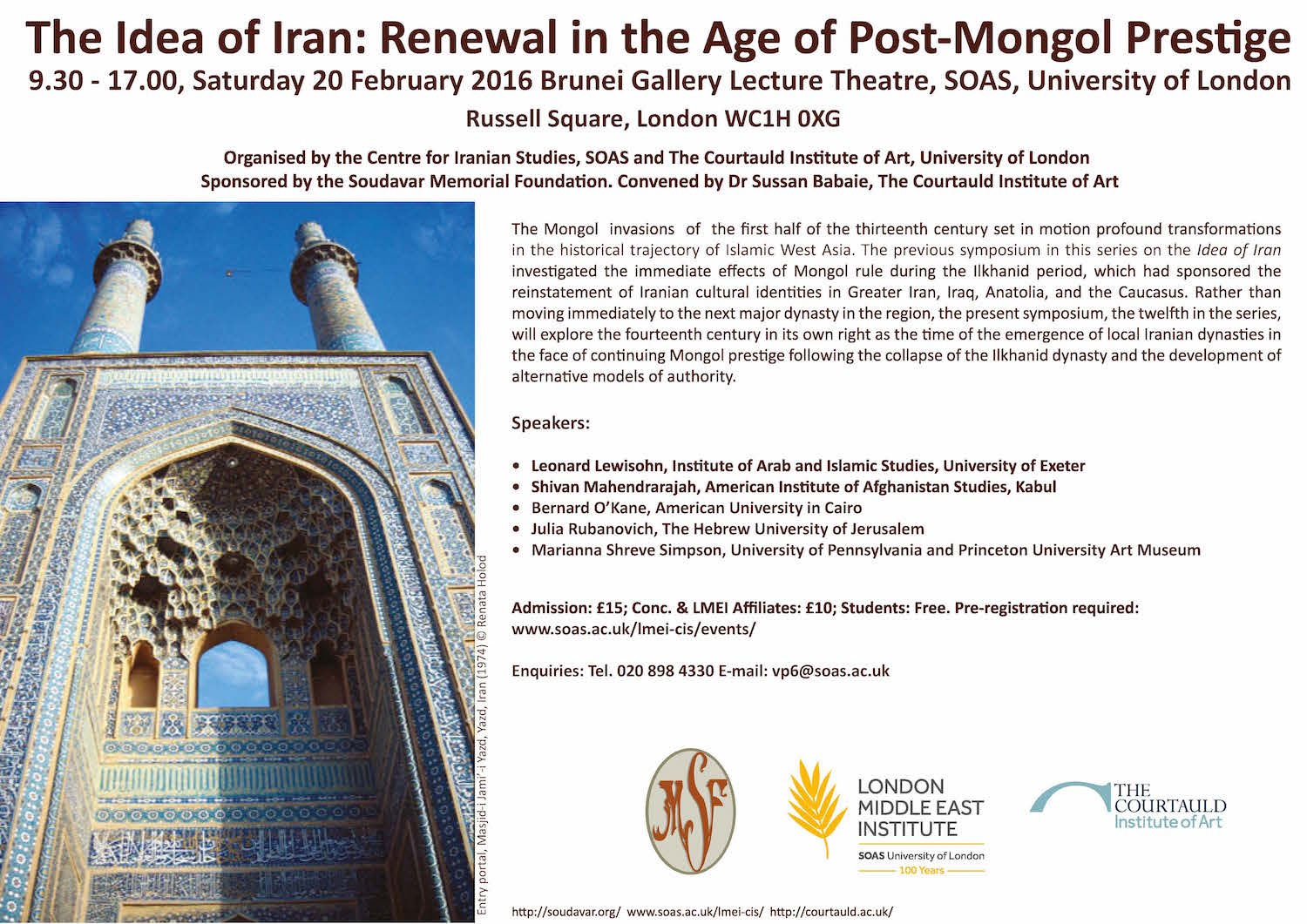
The Idea of Iran: From Eurasian Steppe to Persian Empire
Lecture Series, April-June 2004
About This Conference
Academic and general interest in Iran has been growing steadily in recent years. This lecture series is part of a broader initiative on the part of the London Middle East Institute at SOAS to promote all aspects of Iranian studies. It was organised by LMEI and the British Museum on the initiative and with the support of the Soudavar Memorial Foundation. Scholars from the fields of archaeology, history and religious studies were invited to participate in the first series which covered antiquity up until the late Achaemenid period.
Convenors
Dr Sarah Stewart
Dr Sarah Stewart is Lecturer in Zoroastrianism in the Department of the Study of R...
Dr Sarah Stewart
Dr Sarah Stewart is Lecturer in Zoroastrianism in the Department of the Study of Religions at the School of Oriental and African Studies, University of London and Deputy Director of the London Middle East Institute, also at SOAS. She has been co-convenor of the ‘Idea of Iran’ symposia since its inception in 2006 and has co-edited five volumes in the ‘Idea of Iran’ publication series with I.B.Tauris. She serves on the Academic Council of the Iran Heritage Foundation and has been a longstanding Fellow of the British Institute of Persian Studies, most recently serving as its Honorary Secretary until 2013, in which year Dr Stewart co-organised the acclaimed exhibition: ‘The Everlasting Flame: Zoroastrianism in History and Imagination’. Her publications include studies on Parsi and Iranian-Zoroastrian living traditions and is currently working on a publication (in collaboration with Mandana Moavenat) on contemporary Zoroastrianism in Iran.
Dr Vesta Sarkhosh Curtis
Dr Vesta Sarkhosh Curtis is Curator of Middle Eastern Coins at the British Museum ...
Dr Vesta Sarkhosh Curtis
Dr Vesta Sarkhosh Curtis is Curator of Middle Eastern Coins at the British Museum and is responsible for its collection of pre-Islamic Iranian coins (from the third-century BC until the middle of the seventh-century AD), which includes both Parthian and Sasanian coins. She also looks after coins of the Islamic world beginning with the Umayyad and Abbasid periods and including coins of the Samanid and Buyid, Seljuk, Mamluk, Ayyubid and Fatimid, Ilkhanid and Timurid, Safavid and Qajar dynasties. Projected have included The Sasanian Coin Project, a collaborative project with the National Museum of Iran in Tehran, and now successfully completed. The result is a two-volume Sylloge of Sasanian coins of the third- to seventh-centuries AD while Dr Sarkhosh Curtis currently jointly-directs the International Parthian Coin Project, The Sylloge Nummorum Parthicorum (SNP), and is Joint Editor of the SNP series. This multi-institutional project will record Parthian coins of the third-century BC to the third-century AD found in London, Vienna, Tehran, Paris, Berlin, and the American Numismatic Society, New York.
Speakers
Dr John Curtis
Iron Age II and Iron Age III are periods preceding and leading up to the Achaemeni...
Dr John Curtis
Iron Age II and Iron Age III are periods preceding and leading up to the Achaemenid period and the foundation of the Achaemenid empire by Cyrus the Great in 550 BC. The Iron Age II period at the beginning of the first millennium BC is known from a number of archaeological sites. The most important of these is Hasanlu, southwest of Lake Urmia, where columned buildings, the forerunners of the later Achaemenid apadanas, were found. Typical of the pottery of this period are bridge-spouted vessels of the Late Western Grey Ware type, as well as an attractive kind of painted red on cream pottery, principally known from a cemetery at Tepe Sialk, Kashan. In the Iron Age III period the focus of attention is on the Median heartland, an area bounded by Hamadan, Malayer and Kangavar. The following Achaemenid period will be discussed within the framework of Persepolis and the Oxus Treasure.
Professor Dan Potts
Department of Archaeology
University of Sydney
When scholars talk about the origins of the ‘idea of Iran’, they normally commence...
Professor Dan Potts
Department of Archaeology
Affiliation
University of Sydney
When scholars talk about the origins of the ‘idea of Iran’, they normally commence with the ideologically charged statements made in the Achaemenid and Sasanian sources showing a self-conscious awareness of Iranian ethnic identity and geo-political cohesion. Such an approach is entirely understandable, yet it fails to acknowledge the non-Iranian inhabitants of the landmass we now call Iran, the most well-known of which were certainly the Elamites. As Cyrus the Great and his immediate predecessors lived in what could be termed a late Elamite (Neo-Elamite) cultural and political milieu in the region of Anshan (highland Fars), and were certainly aware of Elam’s political, artistic and administrative ‘culture’, there are good grounds for beginning an inquiry into the ‘idea of Iran’ not with the Persians but with the Elamites. This lecture will explore some of the consequences of such an approach.
Professor Frantz Grenet
The list of “Aryan countries” in the first chapter of the Vendidad has been the su...
Professor Frantz Grenet
The list of “Aryan countries” in the first chapter of the Vendidad has been the subject of countless discussions in the past. It now seems possible to propose a re-examination, in the light of new information which was not available to our predecessors, for example, a better knowledge of the historical geography of Afghanistan in later periods, and a more systematic comparison with geographical data contained in the Rigveda (an avenue explored recently by Professor Witzel). The preliminary conclusions proposed in this lecture result in a compact picture of countries all situated in or near present Afghanistan and Northwest Pakistan, with four sequences of countries all starting from the Pamirian region. Iran in its present borders is not included in the list, which ignores the Achaemenid and even the Median empire.
Event Details
Start date: 29/04/2004
Register for the Conference
Join leading scholars and researchers for this prestigious international conference on Iranian studies.