The Idea of Iran: Renewal in the Age of Post-Mongol Prestige
Conference
About This Conference
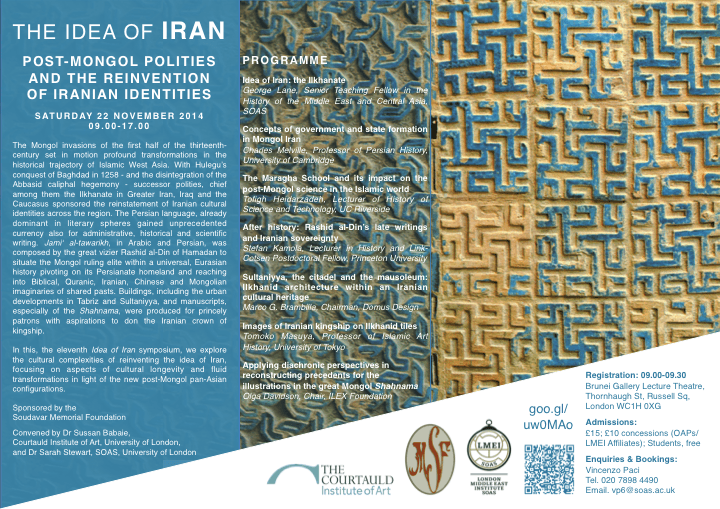
The Mongol invasions of the first half of the thirteenth century set in motion profound transformations in the historical trajectory of Islamic West Asia. The previous symposium in this series on the Idea of Iran investigated the immediate effects of Mongol rule during the Ilkhanid period, which had sponsored the reinstatement of Iranian cultural identities in Greater Iran, Iraq, Anatolia, and the Caucasus. Rather than moving immediately to the next major dynasty in the region, the present symposium will explore the fourteenth century in its own right as the time of the emergence of local Iranian dynasties in the face of continuing Mongol prestige after the collapse of the Ilkhanid dynasty, and the development of alternative models of authority.
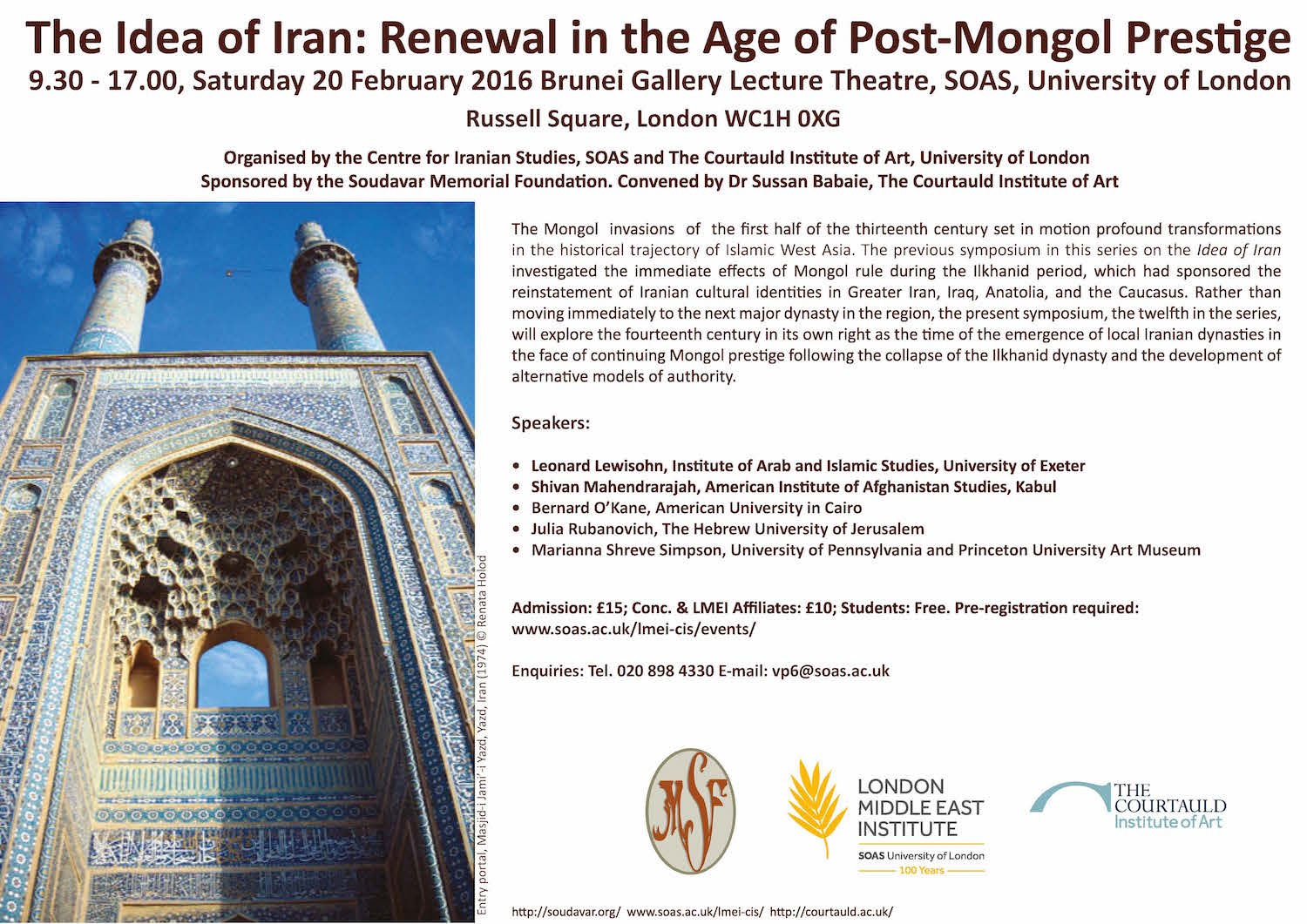
This period is often touched upon only lightly in overview studies, partially because of the comparative scarcity of the sources, and partially because its story is not an easy one to tell, because there is not a single regional polity and dynasty whose trajectory one could follow: By the mid‐1330s, the Ilkhanate in Iran made place to regional successor polities, resulting in a multicephalous cultural, political, and religious landscape, with many regional centers. Each of these made distinct cultural contributions, the most prominent ones during this time being the Jalayirids, Muzaffarids, Sarbadars and Karts. The Persian language, already dominant in the literary sphere, was used increasingly also for administrative, historical and scientific writing. Buildings, including the urban developments in Tabriz, Yazd, Shiraz, and Herat, and manuscripts, especially of the Shahnameh and its imitations continued to be produced for princely patrons with aspirations to don the Iranian crown of kingship.
It is also during this period that we witness the peak of productivity of several of the greatest Persian poets, including Khwaju‐yi Kermani (d. 1341 or 1352), Ubayd‐i Zakani (d. 1371), as well as Hafez (d. 1389), who wrote some of the greatest masterpieces of Persian poetry. Several major historians were active during this period, such as Hamdullah Mustawfi (fl. 1335), Muʾin al‐Din Yazdi (fl. 1356) and Nezam al‐Din Shami (fl. 1404). The fourteenth century was extremely important in the realm of intellectual history as well, producing such major theologians as ʿAdud al‐Din al‐Iji (d. 1355), Saʿd al‐Din Taftazani (d. 1390), and Sayyid Sharif Jurjani (d. 1413), who were mostly active in Fars, especially Shiraz, and the Khurasan region. Several prominent Sufi figures, eponyms of important socio‐political movements and Sufi tariqas, such as Bahaʾ al‐Din Naqshband (d. 1389), Fazl Allah Astarabadi (d. 1394), and Shah Neʿmat Allah Vali (d. 1430), lived and worked in this period, and it is also during this period that we observe the rise and consolidation of distinct Sufi groups with origins in the thirteenth century, such as the Mawlaviyya, Kubrawiyya, and Safaviyya.
This symposium explores the cultural complexities of reinventing the idea of Iran during the period of extreme political decentralization, focusing on aspects of cultural longevity and fluid transformations in light of the competing cultural, political, and religious aspirations in the post‐Mongol world.