The Idea of Iran: From Saljuq Collapse to Mongol Conquest
Conference
About This Conference
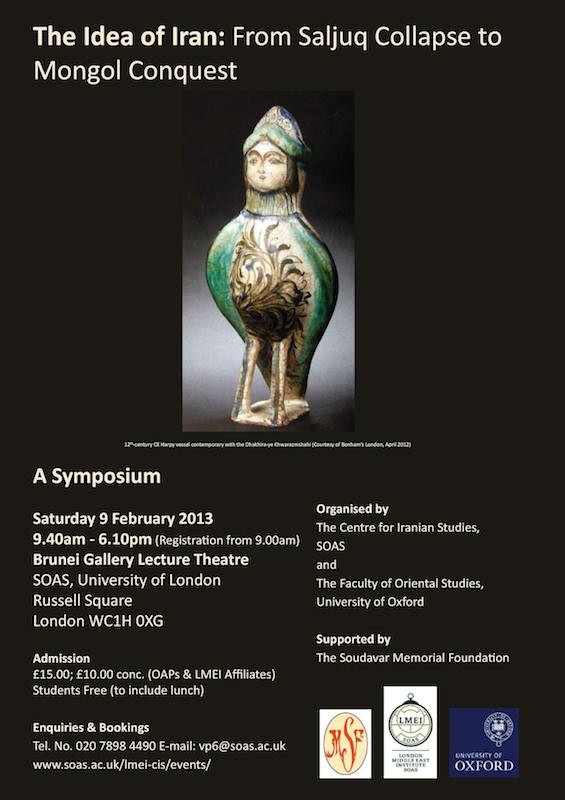
After the death of Sultan Sanjar in the mid-sixth/twelfth-century the Saljuq empire rapidly unravelled, its provinces fragmenting into a patchwork of mostly short-lived principalities and kingdoms. This was the era when the atabegs – originally guardians responsible for the upbringing of Saljuq princes – developed into a series of independent local dynasties, each holding a fig-leaf of legitimacy in the shape of a Saljuq puppet prince. After a time new powers emerged: the pagan Qara-Khitai, in Central Asia; the Khwarazmshahs in Khwarazm, Khorasan and much of central Iran; to the southeast the Ghurids, who contested Khorasan with the Khwarazmshahs while ruling much of Afghanistan, Sind and the Punjab. All of these were blown away by the Mongol conquest at the start of the thirteenth century, an event which contemporaries present as a veritable cataclysm. Neither the breakdown of imperial power and centralized government, nor even the Mongol catastrophe, prevented Persian literature from flourishing: Anvari, Khaqani, Nezami, Attar, Rumi and Sa’di all belong to this period, while other arts and sciences also continued to find patronage.
In this the tenth Idea of Iran symposium, we will explore the complex political dynamics of this age – up to the second Mongol invasion under Hulegu in the 1250s and the establishment of the Il-Khanid state – and will focus also on its extraordinary literary, scientific and cultural achievements.